Showing posts with label Novels. Show all posts

Sunday, August 2, 2015

Developing Plot & Your First Narrative

If you want your story to sell, it's gotta have equal parts of genius, uniqueness, and well developed story elements.  If you have the beastly ability to shape superb dialogue, but lack scene creation, your narrative will ... suck.  If you have amazing world building skills, but fail to deliver meaningful
dialogue, you might as well put your head on the chopping block.  Every element of fashioning a story must be just as strong as it's counterpart (links in a chain, braids of a rope etc ... hear Mr. Miyagi, young grass hopper!).

So let's take a look at one of the elements you might be struggling with, and don't even know it yet.  I'm talking about your plot, my friends.  You see, at first you have this bright beacon shinning inside your head with clear vision on where the story should go.  You've got the big picture all laid out, and writing it out should be simple.

And then you start ... and stop.  Holy plot holes, Batman!  What happened?  You got a few chapters in, set some things up, and now you've got no clue how to drive the story forward.  Welcome, new writer.  Grab a coffee and enjoy a muffin.  You'll be here for a moment or two.

Think about structure.  It's going to help you dramatically (pun intended) with your plot development.  Some writers are able to fly by the seat of their pants, pumping out story after well crafted story.  Usually that's because they've taken the time to master the rudimentary elements necessary to create beautiful literary works.  There are a few different ways to structure your story, and some of it may be dependent on what kind of story you're wanting to write.  Ultimately, using some of these techniques will help you learn how to develop your plot, and perhaps avoid big rewrites, inconsistencies, and plot holes.

The Basics

So what is drama and why does your story need it?  Drama in a story is that factor that makes the reader want to turn the page. There is conflict, unknown outcomes, second guessing as to where the story is gonna go.  All of it is summed up as drama.  Drama can be formed by understanding and using the following elements in your story.  I'll not explain these elements, but you should really go here and read up on them.  They are key to developing a solid plot that people want to turn the page to discover.

1.  Story Goal
2.  Consequences 
3.  Requirements
4.  Forewarnings 
5.  Costs 
6.  Dividends
7.  Prerequisites 
8.  Preconditions

Again, if these terms are completely foreign to you, go here to learn more about them (I've mentioned the same link twice, so you know it's important).  No matter what story you have, creating tension (drama) will make the story fill important.  I discovered a very simple way to do this.

Have two narratives instead of one.  One narrative if for your hero, driving them to achieve the story goal.  The other narrative is for the villains, where they have their own story goal they are trying to achieve. The villain and their plot opposes the hero in every way.  These are the forewarnings in your ultimate plot. When you work at it from these two perspectives, it is like a whirlpool of story, with tension building with setbacks (to either side) until the two forces meet and resolution must be achieved.

If you plan it out well enough, your story will be compelling.  As a beginning author, destined for greatness, take the time to learn how to formulate a plot.  This simple technique will transform you from being scatter-brained, to being a juggernaut of a story teller.

How about you?  Have you discovered a plot development technique that really helped your writing achieve a new, professional level?  Tell us about it in the comments below.  Please check me out on Twitter, Facebook, and Tumblr!  Share the crap out of this if you found it useful.

Friday, July 24, 2015

Writers Fatigue & The Cure

Writer's Fatigue

It is the demonic shadow of the dreaded phenomena that plagues all of us word-smitten creative types.  I'm talking about writer's block and it's nagging companion, fatigue.  Fatigue is a lot like writer's block, and if it's left unmanaged may create the perfect door for writer's block to step right through.  Just like a holy man preparing himself for epic combat with malevolent spirits, we as courageous writers must take precautions to keep the demon at bay.  By the way, I'm totally thinking of John Constantine while I write this.  Gimme some Enochian symbols and I'll brand them (not really) on my forearms (back satan!).
So, what is writer's fatigue?  Basically, it's the same thing as burnout.  You've invested so much time and energy in writing this project.  Your heart and soul have been ground up and mashed into the essence of every laboriously chosen word.  But you've given too much too quick.  Next thing you know, you're not so excited about getting up early in the morning and sitting at that desk.  You try because hey, you know it's not going to be fun all the time.  You've even read elsewhere that it's going to fill a lot like work.  But beware!  Sometimes the right thing might be to brutally master your mind and body, push right through and get that word count in.  And maybe not.

"Why maybe not?" you ask.  Another great question.  Jeez, you guys are really on point.  Maybe, just maybe you'll start to produce less than that high quality work that you know you're capable of.  Perhaps you inner eye begins to haze, and suddenly the clarity of direction is muddied by the work of it all.  Does that sound about right?  If so, you're in the choppy waters of writer's fatigue.  Beware!  There, just beyond the dark clouds is a place of emptiness (the "nothing" from The Never Ending Story has been there), lukewarm waters and (whispered in echoes) writer's block.  God forbid you get to that place.  You've gotta go through hell to get back where you want to be.  And you want those words to flow like milk and honey.

The Cure

Ah, but in my vast amounts of timeless wisdom, gathered and harnessed by the incredible rabbi called "experience", I have learned of a remedy.  Not like the pricey snake oil stuff that Crazy Eddie sales with ol' One Eye's moonshine (what a name for a moonshiner, right?), but the real deal.  So here we go.  I think this next bit of wisdom is so epic it deserves it's own line.


The cure to writer's fatigue is to write more stuff ... just different ... stuff.

Yup, that's it.  The trick is to write something other than the large project you're working on.  Take a break from that novel, but not too long.  You still want to make progress on that thing, so I wouldn't suggest abandoning it for more than a day (if that).  I chose to do a blog which was similarly related to my novel (subterfuge!), and to help edit fellow writers and their monstrous projects.

 I had a professor in college that gave me a bit of advice when it came to studying and writing theological papers.  He told me that your brain needs a break from doing the same thing over and over again, and it helps for the old noggin to reboot if it's located in a different space.

This means that it is good for you head to change gears for a while, and sometimes you need to get up and get out of your local writing haunt to help it out.  Let me simplify:

Change your mental location, and you physical location.

Keep writing everyday.  Write something, they say (I don't know who they are, but they say a lot of things).  Keep your craft like you would keep a hunting knife; sharp and prepared for the work at hand.  Once you've done a little work on another project, perhaps one less meaningful, you need to refocus on your first love.  You'll be surprised at how rejuvenated you feel.  It's like getting a breath of fresh air after being stuck inside a smouldering, ventless attic for hours.  Try it out the next time you feel a little less enthusiastic about your novel (don't go to a stuffy attic, though.  You could die.  I don't want this blog to be the reason for death).

How about you?  Have you had a time when you feel like you're just too burnt out to write anything good?  How did you fix it (did you fix it)?  Do you have any secret chunks of wisdom for us to learn from?  Let us know in the comments below.

As always, please like share on your media sights of choice.  Follow me on Facebook, Tumblr, and Twitter!

Saturday, July 18, 2015

Criticism & Your First Novel

Criticism sucks.  There I said it.

It's not fun, it doesn't feel good, and it's not going to be easy.  David Mitchell, Black Swan Green, said, 

"If you show someone something you've written, you give them a sharpened stake, lie down in your coffin, and say, 'When you're ready'." 

 If you haven't taken this critical (deplorable) step in your quest to become (que superhero overtones) the Greatest Writer in the Universe, pay close attention to this quote ... it's true, and, just like the death of Dracula, you'll feel the torture of every negative word they speak (or write).  Beware, my friends, this road you've chosen to embark upon is one filled with the flayed skin of writers, and the continual, mutalation of their souls.  Criticism to the writer is it's own kind of hell.  Beware!  You must have the skin of a German Panzer to withstand what must be endured.

And it must be endured, too.  If you don't let anyone read your work before you attempt to publish, be it self publishing or through a traditional publishing house, you will be doing yourself and your novel a great disservice.  It doesn't matter how many times you have re-written your story.  It doesn't matter if you edited the holy crap out of it and found it flawless.  Someone, somewhere will find something that needs to change within your work.  

It's Okay.

You know why it's okay?  Because people (other than mom, God love her) can pick out those places in your narrative that are flimsy and weak.  If your dialogue is too boring to keep someone reading, you need to know about it.  They (your critics) will find information dumps where you thought you had none, and stupid, dumb, inconsistencies that you know shouldn't be there.  In short, taking those criticisms will make your writing stronger, better, more efficient, and just freakin' awesome (like the 6 million dollar man).

 But at what cost?  Is there a cost (shifty eyes) ... yes.  There may be a cost involved.

The Problem With Criticism

So let's say you've already spent countless hours researching for your novel.  Now you've gotten twenty, fulfilling chapters pumped out, and have decided that you want others to take a look at it.  You're sold on your work.  You love your work.  It's your baby.  You spoon fed it it's first few days ... changed it's dirty diapers, burped the little farts out of it.  I bet you remember the day when the chapters started to fly from your fingers, too.  Wasn't that a wonderful day?  Writing became quick and furious for you, and you watched your baby grow.

Now you're letting other people hold that baby, and they don't quite think so much of it as you do.  You thought it was damn near flawless, little to no blemish.  But the critics?  Oh man, they've all but dissected it, chewed it up, spat it out, and became a little green because it just didn't settle too well (I've now moved from the baby metaphor to food ... do not eat babies, please ... unless they are scrambled with cheese and from a chicken).  

Then they will rattle off all of these "rules" of writing that you've unknowingly broken.  "Poor thing," they say, "you obviously didn't know ... why would you have written such [insert negative term referring to your writing] if you had known?"  They mention your use of adverbs, and then your dialogue tags ... oh God, what have I done?  I've used "mumbled" instead of "said"!

You've discovered there are all these rules that you should've been paying attention to, and that perfect little baby looks a little more like an Orc (Balruk, runny bowels, he is now called) than a human.  Your heart it broken; you've been torn down, and you don't think you have the courage to pick yourself back up again (one dude even said your work sucked so much that he couldn't read it all).  Perhaps, like me, you contemplated throwing it all away (if I'm that bad, why should I be a writer in the first place?).  

Your work is worth it, that's why.  All those tears, all that hatred and self-loathing ... worth it.

Because you've got a damn good book, and you freakin' know it.  Take the criticisms that are helpful.  Employ the ones that really make your work to shine.  Take the painful criticisms and learn from them.  But don't get bogged down by them.  Make sure you keep pushing forward, ever progressing to that lofty goal of being a working writer (and all the things that means to you).  

I felt like life had ended.  While writing my novel, He the Hallowed, I fell into something like I've described above.  For a day or so I thought I needed to really follow all these rules people kept throwing at me.  Was I really that bad of a writer?  Had I not paid attention to the books I read as research?  I picked up a couple of best sellers from my private library (book shelf) and flipped through them.  

Do you know what I found?

Authors who disobeyed the almighty "rules", that's what.  So be careful that you don't listen to every word that your constructive critics suggest.  What they say, no matter how they say it, doesn't make them unaltered laws that you have to follow.  I'll leave you with another quote to simmer on until next time:

"In theory it was, around now, Literature.  Susan hated Literature.  She'd much prefer to read a good book." -Terry Pratchett, Soul of Music

Okay, one more:

"If critics say your work stinks it's because they want it to stink and they make it stink by scaring you into conformity with their comfortable little standards.  Standards so low that they can no longer be considered "dangerous" but set in place in their compartmental understandings." - Jack Kerouac 

For more quotes on novels and criticisms, check this out (all of the above quotes were derived from goodreads).  Sharing this stuff encourages me to write it.  If you feel encouraged by what I write, please follow me and sp-sp-sp-spread the word!

What do you think of criticism?  Have you ran into other writers that preach "rules" like a Southern Baptist on the sinner's prayer?  Let us know about it in the comments below.


Saturday, July 11, 2015

Write It Where You Are

Wandering off into the world to write you heart out takes a lot of moxie ( I love that word), finesse, and plain old determination.  In my last post I spoke about the heart of adventure writing being about the removal of thyself from your local writing haunt, and gaining inspiration from your environment while you work.  I have found this process to be very helpful while creating my narratives in a few different ways:

1.  Setting 
Writing scenes are easier if you are in the scenery (or a similar setting) that you are writing about.  Think about it; how many times have you been scratching the old skull-noggin, trying to figure out what realistic, mundane detail could give your work a tinge of reality.  I personally love to have my characters pick their nose; a simple, gross thing really, but let's face it...there are two kinds of people in the world: those that pick their nose, and those that lie about it.  A similar setting will work too.  If you are writing about an ancient bazaar from a more antiquated time, go to your local flea-market and see how people haggle and interact with one another.

2.  Over the Wall  
Silence, peace, and distraction free...the forceful way.  Sometimes when I need to write,  I really don't want to.  Sometimes writing is way more of a job than a career (jobs suck, careers are fun).  I found that packing up my stuff and hitting the back country put me in an environment where I had nothing else to do but write.  It got me through some tough, dry spots and helped me push through.  I'm not saying the writing is always going to be without it's flaws, mind you, but I am saying that you can force yourself into keeping the pages rolling.

3.  Inspiration   
Sometimes you need to get out of the house and away from things that are familiar to get some inspiration.  It's important to recharge your creativity tank, and the way I've found to do that is to go somewhere beautiful that is quiet where I can think.  I've sat on top of lonely mountain peaks overlooking rolling hills and valleys while conversing (like a crazy man) with my main character about why he would do the things he does.  Sometimes I think about the big picture, or shout out my frustration to a godless sky.  But I always come away with some kind of fruit for my works, even if it does mean a major rewrite (why!?  Why can't it ever be good enough!).


THE CAMPER, THE HAT, AND THE BABY 'SQUATCH

One of my first adventures ended quicker than I originally planned.  I was having a really hard time concentrating at the house, and I kept finding other, more interesting things to do (I sat on a couch mouthing the word "bored" over and over again for days).  I had been planning the trip for a few months, researched the crap out of the gear I needed, finally figured out how to solve the all important power supply issues, and gathered up three day's worth of freeze-dried foods (food is important.  I like food.  Food doesn't like me.  I've also been bitten by the diabetes bug.  I need food).  

I kissed my wife good bye, told my seven children "toodles" and then dashed out the door.  I got in my 1988 Ford F150 rust bucket, floored it up into the mountains, and hiked my happy butt deep into the wilderness.  It was early in the morning, and early spring, too.  The weather had been in the 70's for the past two weeks, and I swear...I...swear...the weather was supposed to be sunny, warm, and only in the 60's at night.  That was probably true where I lived in the valley, but it was NOT true in the high places!

So there I was, the air quite chilly, ready for my own personal adventure.  I hiked all morning out to where I wanted to be for three days, enjoyed the solitude for a moment or two, and then hung my hammock.  The first problem I encountered was the amount of people that happened to frequent that part of the trail.  I was not the only person who thought the area was pretty, apparently.  I forgive the passersby, even though one guy stayed and chatted it up for an hour and a half.  After I got my camp all gussied, I hopped in my warm hammock nest with my trusty laptop in hand, and began pounding away at the keys.
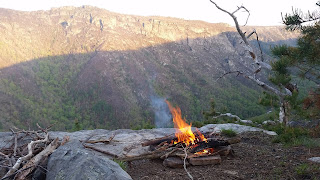

All was well.  The sun was warm during the day, even if the air was a little chilly.  That was okay, you know?  I enjoyed my quiet time, and got pretty far in a chapter.  Soon the sun began to dip below the Western ridge line, and the dreaded shadow of on coming night was upon me.  I'm sure you're thinking I kept working, feverishly engulfed in my own, twisted genius spilling out onto the digitized page...I did not.  Nighttime meant sasquatches, bears, and balrog, not of which I was prepared to battle.

I took my nightly regimen of pills, and decided that, while the twilight still held, I would go ahead and knock myself out with my sleeping pill (which never, EVER kicked in).  The night came, and from the seasonal pond near the camp came the familiar chirping of the crickets and the grumbling calls of the tree frogs.  I thought to myself, "as long as the critters still call, nothing big is coming through.  I'll be fine."  

Silence. 

 Holy terror of satan himself.  There wasn't so much as a cricket's fart, it became so still.  I reached out in my pack (only a foot away from me), grabbed my can of bear spray along with a little bar-shaped flashlight.  I held it tight the whole night, too.  I kept imagining some hairy foot sticking out from underneath my tarp shelter, the angry  face of Harry  from "Harry and the Hendersons" staring down at me.  If not sasquatch then a bear, perhaps, come to paw at the big, greasy meat sack that I was, hanging from a tree like a bagged lunch.  Then there was the balrog, ready to drag me to hell.  You see, during the day you might hear the rustling of the leaves in the woods and your mind  says, "oh!  That's a cute little fury squirrel!"  At night though, everything is bigger.  The same sound then produces, "Oh Mother of God!  Sasquatch, yetis, devils and giants!"  Needless to say, I didn't sleep much, though I do remember passing out for about an hour or so.

The worst part was waking up in the middle of the night to the sound of chewing.  God awful, mouthfuls of flesh being savagely torn asunder.  It was my worst nightmare.  I new it was a bear (sasquatch) eating out of my pack.  Being the careless camper I was, I kept my food right by me too...not a foot away.  I grasped on tight to my flashlight and bear (sasquatch) spray, and tried to gain the courage it would take to move and vanquish my worthy foe.  Believe it or not I did...I did!  I had the courage!  I peeled back my nest quickly, pointed the light and...

Blinded myself.  

The freaking flashlight was pointed right at me.  By the time I turned it around and adjusted my eyes to the now pitch black darkness, whatever was there was gone.  I calmed myself by assuming it was just the hammock bouncing up against the pack, and that no little creature (sasquatch) was munching in my pack.  It was, after all, sealed up nice and tight.  But the sound of chewing continued.  I had convinced myself enough and ignored the sound, which went on most of the night.  
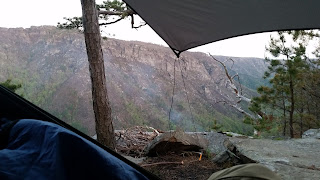
By the time the grey of morning came,  I was very tired...tired and really, really needing to use the bathroom (defending oneself from sasquatches all night may cause you to be too scared to go pee-pee).    So I sluggishly got out of my hammock and started to head back into the bush.  I didn't have my glasses on.  Why didn't I have my glasses on?!  If only I had my glasses on, I could have positively identified the  baby 'squatch (raccoon or opossum) that scurried away from my area.  I went and did my thing, watched the sun come up over the mountains, and then packed up and left (I check out of hotel Scare-the-%#*@-out-of-you two days early).  One of the last things I did was put on my Boston Red Sox ball cap.

You know what I did with that hat the year before?  Swam in the ocean with it.  It was as salty as the sea, and probably more so from my own sweat, too.  When I got home and took a nice, long, hot shower, I got dressed and reached for my hat.  It was then that I noticed a small, chewed through hole in the band of it!  Whatever the creature, it must have been after the salt in my hat, and had hung out with me the whole night to get some.

You want to know what I learned?  Solo camping in the middle of nowhere is terrifying!  But it gave me an experience I'll never forget. Not to mention, it gave me a way to jump start my creativity and really open my world up to new possibilities.  

Have you ever had an experience like that?  If so, tell us about it in the comments below.  Please remember to share this stuff and pass along my chicken-nuggety bits of writing awesomeness to your friends!